What Can a UX Assessment Do for Your Startup?

You’re all set for the market, you have a great product…but it’s not enough. The experience that users have when interacting with your product would be the make or break factor for your success. Your user experience would be under the spotlight for your business.


UX is an often overlooked step in the journey of a product’s conception, yet it plays a pivotal role in determining a business’s success. Startups that prioritize UX have seen remarkable benefits—research shows that every dollar invested in UX can yield a return of up to $100, and companies focused on UX design outperform their competitors by 219% in the S&P index. For instance, Airbnb’s focus on UX early on helped transform their platform into a seamless and intuitive experience, driving user trust and exponential growth.
However, businesses often face the challenge of scaling efficiently while keeping costs in check. This is where conducting regular UX assessments becomes invaluable. By uncovering pain points and identifying opportunities, UX assessments provide actionable insights that help startups grow smarter—not harder. In this article, we’ll explore how UX audits can benefit your business and drive sustainable growth.
Why Get a UX Assessment at an Early Stage Startup?
Your product’s success hinges on the experience users have when they engage with it. UX audits identify areas where your product might be underperforming, pinpoints frustrations, and helps optimize the experience—paving the way for a base of loyal customers.
Additionally,
- A UX assessment helps fix usability issues before they become bigger problems.
- Startups need quick iterations—UX audits offer actionable feedback.
- It helps in building brand trust through seamless user experiences.
What Startups Need to Know: Playbook of UX Auditing
A UX assessment is an evaluation of your product’s user experience with the goal – find areas where users struggle and where the design, navigation, or overall functionality could be improved.
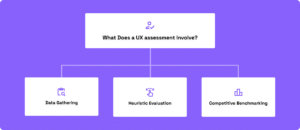
What Does a UX assessment Involve?
- Data Gathering: UX audits start with gathering data from multiple sources. This could include user feedback, website or app analytics, session recordings, heatmaps, and more. This data offers an objective look into how users interact with your product, what pages or screens they spend the most time on, and where they drop off.
- Heuristic Evaluation: A heuristic evaluation is a method where UX experts assess your product against established usability principles. This step helps identify immediate usability issues, such as navigation difficulties, confusing layouts, or missing functionality.
- Competitive Benchmarking: Understanding how your product stacks up against competitors is also important. Benchmarking in a UX assessment helps you see what others in your space are doing well and where your product could stand out with a stronger, more user-friendly experience.
Smart Moves for Startup Founders:
- Involve UX professionals early: Waiting too long to evaluate your UX can lead to more complex and costly redesigns down the line. Getting a UX assessment early in the development process will help catch usability problems before they grow.
- Focus on quick wins: Not all UX improvements require massive overhauls. Some changes, like fixing confusing navigation or optimizing button placements, can have a big impact with minimal development effort which can be detected through a UX Audit.
- Look at the big picture: Apart from immediate usability fixes, a UX assessment also reveals insights that can influence your product roadmap, helping you prioritize features and designs that align with your users’ needs.
How Regular UX Audits Can Drive Startup Growth
One common misconception is that UX audits are a one-off process. On the contrary, user needs and behaviors change over time, especially as startups scale and add new features or services. Regular UX audits offer startups the opportunity to keep up with these shifts and ensure that their product continues to serve users effectively.
Benefits of Regular UX Audits:
- Continuous Improvement: Each assessment help you discover new insights that can improve your product’s user experience. By making incremental changes based on this feedback, you can ensure your product evolves in sync with user expectations. This process also helps avoid major, disruptive overhauls later on.
- Customer Retention: A smooth, intuitive user experience increases customer satisfaction, leading to higher retention rates. When users enjoy engaging with your product, they’re more likely to stick around and recommend it to others. In contrast, poor UX can lead to frustration, causing users to churn.
- Conversion Optimization: UX audits assist in revealing bottlenecks in conversion funnels, such as clunky sign-up processes, confusing checkout pages, or unintuitive call-to-action buttons. Fixing these issues can lead to higher conversions and better business outcomes.
- Scalability: Startups are constantly evolving. As your business grows, so will your user base. UX Auditing helps ensure that your product can scale effectively without introducing new friction points for users. Whether you’re expanding to new markets or adding new features.
- Investor Appeal: Investors want to see a solid foundation for growth, and having a user-centered design approach is an attractive feature. Startups that can demonstrate a commitment to UX and back it up with data from regular audits often stand out to investors as well-prepared and forward-thinking.
Get a Sample Audit Report now!, Learn how to skyrocket your user adoption & retention!


